Category: Healing Therapy

  • Announcing TechnoTherapy

    Hi everyone,

    I have decided to focus my longer-form online efforts around a new org, TechnoTherapy.  The vision is to hold a space for the integration of mobile/web technology into the work of behavioral health professionals.  Please check out the site by clicking on the icon below.  Really excited about this new adventure!

    LogoColorTextBelow

    This site will continue to be an archive for longer-form personal reflections and sharing.  To connect directly, and for shorter-form shares, connect with me via FaceBookTwitter,  and LinkedIn.

    With love,
    Vikram

  • SEPTEMBER Somatic Experiencing Mnemonic

    A memory aid for rapid application of Somatic Experiencing technique for PTSD discharge.

    Numbered text below taken verbatim from p. 75-76 of Dr. Peter Levine’s
    In An Unspoken Voice: How the Body Releases Trauma and Restores Goodness.
    I strongly recommend purchasing and reading the book, and working personally with an experienced practitioner before attempting to apply this mnemonic in a self-directed way.

    S – Safety: 1. Establish an environment of relative safety.
    E – Exploration: 2. Support initial exploration and acceptance of sensation.
    P – Pendulation: 3. Establish pendulation and containment: the innate power of rhythm.
    T – Titration: 4. Use titration to create increasing stability, resilience and organization. Titration is about carefully touching the smallest ‘drop’ of survival-based arousal, and other difficult sensations, to prevent retraumatization.
    E – Empowerment: 5. Provide a corrective experience by supplanting the passive responsees of collapse and helplessness with active, empowered, defensive responses.
    M – Mobilization: 6. Separate or ‘uncouple’ the conditioned association of fear and helplessness from the (normally time-limited but now maladaptive) biological immobility response.
    B – Breakthrough: 7. Resolve hyperarousal states by gently guiding the ‘discharge’ and redistribution of the vast survival energy mobilized for life-preserving action while freeing that energy to support higher-level brain functioning.
    E – Equilibration: 8. Engage in self-regulation to restore ‘dynamic equilibrium’ and relaxed alertness.
    R – Re-connection: 9. Orient to the here and now, contact the environment and reestablish the capacity for social engagement.

    Using the SEPTEMBER mnemonic to personally apply the Somatic Experiencing technique has been instrumental for me in safely working with and discharging traumatic charges.

    __
    SEPTEMBER mnemonic text & this page is copyleft Vikram Surya Chiruvolu, 2012. 

  • Getting started with meditation

     A friend recently asked me about my view on how to get started with meditation.  Here’s my answer in the form of five keys.

     The first key is — know that meditation is anything that centers you, purposefully. Different people at different times in their lives have different practices that help them meditate, because there are different causes of being off-center and an endless number of methods of intentionally re-centering.  In addition to very traditional methods of sitting meditation, I personally know people who meditate by knitting, running, playing music, martial arts, painting, attending support groups, and many, many other things.  One of the most important things about re-centering, finding balance, is that it’s a mainly just-for-today thing, a constant course-correction process. 

     Which leads to the second key — spot check. Take one minute to do a back-of-the-envelope inventory. How are you doing in terms of balance in some key areas — rest / activity, diet / elimination, work / play, solitude / social time, mental / physical, stability / change?  You may have your own axes of assessment — use them.  The key is to see if there any areas where you’re consistently further to one end of the spectrum than you know is healthy for you, or are falling short of what you really want or need?  Once you are in touch with what’s not quite right about the complexion of your life right now, ask, what can I do that might help?  Try to keep the answers simple and specific– like — “need more quiet”, or “get exercise” or “make music” or whatever.

      Over time, make the spot-check a continual habit. I’ve benefited from setting a timer on my computer or cel-phone for various lengths of time or times of day — every six minutes, every hour, at meal-times, before bed, etc, to pause and do a momentary check-in and undertake a gentle course-correction.  The more frequent the course-correction, the gentler the invention usually.  If it’s every six minutes, I usually just take a deep breath, stretch my arms or twist in my chair, and continue what I’m doing.  If I don’t do it for weeks or months, I can need a long vacation and lots of effort to find that clarity and center again.

     The third key is — creative action. Once you know what you need, choose a simple practice or method to help begin to restore personal balance — ideally, a way you’re already know you are pretty skilled with or enjoy.  For some people, having solitary highly-focused desk jobs and car-based commutes, the key things they need to restore balance is vigorous exercise of some kind and an opportunity to be social in a creative way, like playing music or dancing. For others, who are working on their feet, dealing with the public, multi-tasking, using public transit, the key thing is time to be alone and do something very simple, like sitting quietly just watching the breath rise and fall.  Choose a practice that you know you can definitely do — it really can be anything that you think will work to help center you, like sitting quietly for ten minutes just observing your mind, or going for a short jog, or jamming out musically with friends once a week. If you’re choosing something you’ve already done before — sport, art, music, just sitting doing nothing — it’s important that you now choose to do this practice with a primary intention of centering yourself, of restoring balance in your self and in your life, not with any external goal. That’s what makes it meditative; without this intention clear, it’s just not going to work consistently as meditation.

      The fourth key is — commit to a regular effort.  When getting started, make the commitment for a brief but substantial time frame, say ten minutes a day for three weeks, or once a week for an hour for six weeks.  Then, see if the benefit you experience is worth it.  Especially when starting out, the deeper benefits require some consistency to realize themselves, so an initial commitment to a specific practice for a specific time frame to get yourself over the hump is key.  For me, I have three 1-hour commitments to yoga and meditation on different evenings of the week that I do with groups, and I put them into my calendar and treat them as real and important as any other appointment, deadline or commitment in my life.

      Fifth — get curious. Be open.  Go where the practice leads you. Whatever the specific practices of centering you work with, as soon as they start to work, you are likely to become  inspired to deepen your knowledge and connection to various techniques or traditions behind them. Honor that curiosity, that calling–for many, it is the most powerful way to opening new creative possibilities, resolving long-standing issues, and fostering personal growth that leads to greater peace, contentment and success.  

      Last (same as the first) — remember the point. Like anything in life, if you don’t experience the benefit, you won’t continue for too long. So this is the single most important thing for the beginner — do not confuse the various techniques and traditions of meditation for the essence of it.  The essence of meditation is centering, and you can achieve this on your very first day of conscious effort at taking a spot check, choosing a practice, and doing it.  

      As your practice deepens and evolves, the techniques and traditions can open up new possibilities and new growth but they still should be done with this basic intent firmly in mind.  There is an art or a science to many practices, valuable for their own sake as well, and the specific mental, verbal, physical, breathing and movement techniques of meditation that exist can lead to tremendously accelerated growth and deeper peace. Yet when those aspects overshadow the basic personal purpose of centering, it’s time to remind yourself of this purpose, and either accept that what you’re doing is no longer meditation, or return to doing it in a way that is.  So remind yourself of this intention whenever you begin practice and whenever it seems to have slipped away in the course of doing it, and you’ll again experience the benefit. This mindfulness is key to any practice working.  

      So these five keys are what make any method of meditation work: mindfulness of intention, regular spot-check, creative action, commitment, and curiosity.  Keep applying these and whatever shape your meditation efforts take, you will experience the benefits and make steady progress.
  • Healing Visualization Meditation

    If there’s any part of my body in need of healing, whether from a fall or other injury, from being ill, or tension caused by stress, sadness or resentment — there’s a simple healing visualization meditation using the breath that I’ve found always helps me feel better.

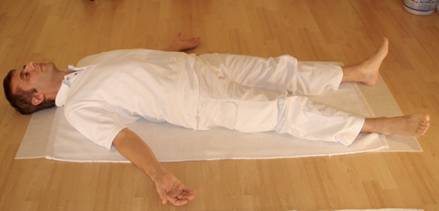
    ·         In a quiet, private place, sit in a comfortable seated posture that you can hold for a long period with your core supporting you (not against a backrest), or, if you’ll be more comfortable, lie down in savasana. Close your eyes throughout the meditation, and bring the focus of your mind’s eye to your body.

    Image003

    ·         Breathe deeply and steadily in through your nostrils into your tummy, then into your chest and heart space then up to your shoulders and neck — and slowly and intentionally release down in reverse order from the neck through the bottom of the tummy.  Inhale only through the nose, but you can exhale through both the nose and mouth, allowing whatever is most easeful for each breath.

    ·         Make the length of your breath on a 1 to 2 ratio.  So if you do a 4-count inhale, do an 8-count exhale.  Find a comfortable, sustainable pace, and don’t focus too much on the exact timing – it’s just a rough guide – but don’t forget to remind yourself either when needed.  Your body will inform you with each breath what it most needs. 

    ·         Once you’ve found a steady pace at about this 1:2 ratio, continue breathing long, deep breaths in this manner, and, as you inhale, visualize sending the breath all the way to the place in your body that needs healing and allowing that part of your body to fill up with healing energy, as your torso fills with breath.  As you exhale, visualize the body gently releasing some of the pain, resistance, anxiety,  sadness, or toxins from that part of your body, and the out-breath carrying it away, out of you.

    ·         At  any point, it may happen that the part of the body you are focusing upon suddenly feels much more easeful or less painful, and seems to have had ‘enough’ healing for now, and  some other part of the body will register the need for healing energy. When it happens, honor it, give thanks to that part of your body for healing itself – and with your next breath, you can shift your visualization of healing energy to the next point in your body asking for it. 

    ·         This works on any part of the body, not just over the parts over which you have conscious control —  even your brain, your heart, the insides of your bones, your eyes, anywhere — you don’t need to be able to consciously control the function of a part of your body in order to send healing energy there.

    ·         Continue for at least a few minutes, as long as you wish, up to a few hours even. 


    If at first you can’t feel your healing energy focusing itself where you’re visualizing, don’t worry – it’s in you. This will become more apparent the more you relax into it.  Often, I know it’s beginning to work because I feel a mild tingling in that region of my body I’m focused on – quite literally, my cardiovascular system is relaxing in that area, allowing more blood to flow in, and with it, more healing happens – more nutrients, oxygen, and white-blood cells go to that part of me — and more red blood cells to carry away by-products and toxins.  With some practice, you will be able to focus your healing energy wherever it is most needed with ease, and the sensations will be unmistakable. 

    If you’re comfortable with this simple practice, you can experiment — as you breathe out, while keeping focused in the flow of healing energy through the body with the breath, you can experiment with different out-breaths and sounds — nose-only, mouth-only, sighing, cooing — whatever is most easeful, whatever provides the most release.  One that really helps me is to sigh like I’ve just finished a big job.


    For those with old emotional wounds – often currently expressing themselves through depression, anxiety,  compulsivity, or trouble focusing or sleeping — coupling this exercise with yogic postures can help accelerate the healing process tremendously.   Deep emotional releases may occur, as there are often many tensions held in the body from un-processed events over the years.  For example, bodywork healers have long known there is often tension stored in the deep musculature of the hips to do with old injuries to one’s emotional security.


    One such experience I have had is of emotional memories coming up of the loss of my grandfather, who was I’m told was my ‘best buddy’ as a small child, until I was two years old, when my family emigrated to America.  He died shortly thereafter. I have no visual, cognitive, olfactory or other memory of my grandfather, but I did have emotional memories of my loss of him held deep within my body, that came up through the combination of this deep releasing breath and pigeon pose on my left side.  I found myself quietly crying tears I had needed to for nearly thirty years, re-connecting with the spirit of a man I had long thought I’d lost, and feeling my load in life is a good bit lighter ever since.


    As soon as you’re just a bit comfortable with this practice and can quickly focus your healing energy  —  you can try to do it any time of day while doing anything – simply taking a deep breath and directing the healing energy to whatever part of your body may be tight or troubled.  For me, it works especially well to direct the healing energy to the front of the brain when I’m a bit mentally astir about something, and the tummy when I’m anxious.   I’ve done it often at my desk at work, in the line at the store, walking down the street, even in the middle of a challenging conversation.  When I can do it, it always helps me — let me know if it helps you too!