Category: Exploring Spirituality

  • Paths Many–Truth One

    In response to this article from Dr. Aseem Shukla in the Washington Post online entitled The Theft of Yoga, and comments from Deepak Chopra and many others — Love and Light to you all!

    In the healthy debate over the origins and intentions of yoga,  please let us not lose sight that – in those first ancient words of the Dao De Jing – The Way that can be spoken is not the True Way. 

    Hinduism, Yoga, Hatha, Dharma, Asana ….  These are all made-up words, first created by seers to aid seekers on their path.  Then, others carried those words beyond those first compassionate offerings — some in the same spirit –but others to build walls of ignorance out of fear, walls through which seekers must even now struggle to move through.   Either way, the words were never, and even now, are not Truth.  At best, they are aids on our journey.  At worst, they are sources of division and difficulty.   

    Let us pray we choose to allow these words to aid…. And may we reaffirm now in our hearts — words are not Truth and cannot contain Truth.

     Only We can do that, in how We live, and love and serve one another.  This is true regardless of the place, time, and nature of the chosen path. 

    Whether through athleticism (hatha), devotion (bhakti), song (bhajans and kirtan), service (seva), ritual (tantra), sacrifice (yajna), sensory indulgence (vama), renunciation (sanyaasa), individualism (ahamkara), communism (saamyavada),  knowledge (jnana), investigating the mind (raja-yoga), repetition (japa), life science (ayurveda), dance (natya), martial arts (dhanurveda),  despair (vishada), fellowship (sangha),  spiritual suffering (tapas), laughter (haasa) —  all these, and many other approaches, tools and methods — when practiced with the spirit of sincere seeking, have led people in every place and time to awakening, and to people teaching one another how they did it.

    Some paths explicitly set out with that aim, but all paths arrive at it eventually, through the inherent virtue of their sincere practitioners. This consistent fact — that people awaken to Light and Peace whenever they honestly try — this is the evidence that there is a Truth, and that It is beyond all words and methods, and is reachable by anyone.    

    This is as true in America today as it was in ancient India, which is why above I used the English words for these diverse practices first — they are techniques, just as scientists use in the lab.  They are not the province of any one culture, but, while they have their historical and cultural roots to some extent in particular places and times, they are our common human heritage. 

    In America, it is the founding premise of the republic.  Jefferson wrote in the American Declaration of Independence –

    We hold these truths to be self-evident, that all men are created equal, that they are endowed by their Creator with certain unalienable rights, that among these are Life, Liberty and the pursuit of Happiness.

    America begins speaking of self-evident Truth.   

    Yoga is  ancient India’s name for the process of awakening to this Truth – of coming into Union — whatever the path. But Union with what exactly?  A traditional answer is Union with Truth, God, the Infinite, the Universe, or however you call your higher power.   

    My experience on my path thus far is that when one experiences this Union, it can happen as a sudden intuition of mystic unity with all that Is.  I had such a moment when I was 19,  in my home near Washington, looking out at evergreen trees, and realizing that we are not separate, that everything is deeply bound together, that even in that moment, I was breathing in the air they had just breathed out, that always, we are in this intimate, interwoven web of life and being.  

    That experience I cherish, and it led me to my first deep relationship with a spiritual teacher — my great Uncle NC Surya.  But I’ve also seen in the years since that the more substantial change occurs gradually, in stages, as the intuition of unity takes a great deal of work to integrate fully, and the more it does, the more the ‘with’ part (of Union) slowly drops away — there is less and less of an other with which to unite.  It is a state of completeness or fullness unto itself.  In this way, the Self evidences Truth, by direct experience.

    In America, reading revolutionaries like Paine or Jefferson, or philosophical forefathers like Locke, one is hard pressed to imagine that these men didn’t also have spiritual experiences and lives.  Somewhere, they found the courage to imagine and bring into being a society based on such self-evident Truth as the equal rights of all.   Yes, it was deeply flawed — they were not perfect any more than many Indian swamis and yogis who still, at some level even if not publicly, cling to ancient caste, class and gender distinctions. 

    The beautiful thing is  — in America,  awareness of self-evident truth is not some rarefied state only some select few attain; it is our birthright.  In India, living in this Truth is well understood to be our most universally shared experience — not only with countrymen, but all human beings, other animals, plants, the Earth, Sun and stars. 

    In any place, we can just forget or ignore it sometimes (or a lot), and separate ourselves from each other, believing how we differ is greater than what we share. 

    That is a great falsity.  We are One.

    The ancient Eeshavasya (“Lord’s Abode) Upanishad is a revered mantra which beautifully expresses Union, as that fullness or completeness, which is the Lord’s Abode, the dwelling-place of Truth:

    Purnamidah Purnamidam
         That is complete — This is complete
    Purnaat Purnamudacyate

        From That Completeness comes This Completeness
    Purnasya Purnamadaya

        If we take away This Completeness from That Completeness
    Purnameva Vashishyate

       Only Completeness remains

    Click here to download this beautiful recording off Ravi Shankar’s Chants of India. 221 KB

    … So …  Relax. You are held — in Truth, in Completeness – and so are we all.  When that sense of ease arises, then Union with that Truth which cannot be spoken, is possible.

    Now what is the aim of this Union and the peace that comes with awakening to It?

    When an ox, famer and plow are yoked together, they create a new life-giving entity that prepares the field to issue its bounty. The point is not merely to learn intellectually how to unite the ox and plow, or even to do it just once; that is but the beginning of the useful work that happens.  Once united, the ox, farmer and plow have their ultimate purpose fulfilled in the harvest, and that bounty is also dependent on their careful cooperation with nature, and grace of Earth and Sun to provide life-giving conditions. 

    Similarly, yoga is the work of plowing the field of life, of staying connected to Truth, and serving It.  So it is with all forms of sincere seeking – growing in a deep, heartfelt, intuitive way into one’s right relation to the universe and oneself — as a part of a whole, as a part that can see and know the whole, and thereby honor it and make the conscious choice to align with it. This work naturally, gradually gives rise to the life of service that results from such Union. 

    Just as there are many processes by which one may experience such Union, there are even more ways in which this knowledge in turn issues out in action — through love, service, generosity, devotion, art, inquiry, scholarship — these are but a few ways of honoring one’s own Truth, of enjoying the experience of It while fulfilling one’s duty  to abide It.

    Being a yogi is in fact our natural condition.  It is our choice, whether to invite all the words, ideas, and practices either to lead us astray into confusion, conflict and harm, both internal and external – or to lead us back home into our Selves, our Truth. 

    So, once again — we must remember always, the Way that can be spoken is not the True Way.   The True Way is found only in our own experience on our own path, and it is our personal Truth.   One way I feel I have drawn closer to It is when I can recognize deeply, intuitively know, that my experience of It is the same Truth that others have found, that there is but One.

    Along the way, I’ve long felt there’s no great mystery to awakening people once I learned what  — usually, they are deeply humble, non-judging, and forgiving, ever growing in dignity, in their capacity to love themselves and others, in laughter and joy,  in their ability to behold beauty, and in being true to their heartfelt calling in  life.  To me, this is the real-life four-dimensional moving picture of yoga.  It knows every country and language and every era. 

    So finally, with the frame in which we are asking the question on firm ground — we can meaningfully turn to the debate of Dr. Shukla and Dr. Chopra – is yoga as practiced in America aware enough of its roots in Hinduism? 

    My view is that I say this is not a good question to ask, for three reasons. Two I’ve already addressed — first, the falsity of discursive, verbal truths, and Truth of direct experience — and second, the understanding that the essence of yoga is universal — that yogis have been in every era, in every place.  

    So the answer for each of us on a personal level depends entirely on whether we have yet come to know what is our personal yogic path, and whether we are called to the ancient Vedic, Buddhist or Christian roots, or to the modern, diverse global branches of every kind.  None are wrong; they are simply preferences for an entry point to a Universal journey.  They all lead to the same place, even if they are not trying to lead anywhere, if we are sincere seekers, the needed path will reveal itself.  The Truth is that powerful. 

    If you are called to the Vedas or asceticism or rigorous hatha practice, wonderful!  These are tried and true ancient paths.  They are often slow, but sure.  If you are called to modern teachers and teachings, that’s wonderful too. 

    Even drug abuse or gluttony or sexual addiction can serve the intention to find freedom from suffering, if one has turned to those things sincerely seeking a way out of suffering and into the light, even those clearly harmful paths will reveal Truth in due course, by demonstrating the wisdom of abstinence or moderation as appropriate for you, and leading you to people who can help you along such a path. Needless to say, those are far riskier and more painful roads, and the suffering you endure may overwhelm this body you inhabit, before the needed moment of clarity and awakening arrives in this lifetime.  

    But the awakening to Truth can also come much more decisively and quickly, if one chooses to use the pain of their path as fuel for spiritual growth.  I have seen many, many people come into direct and deep communion with their Higher Power in just such a way, of healing the pain of various self-imposed harms, then leading the way to healing the pain of all our life experiences, our past karma. 

    Karma lives on in many ways — painful memories, phobias, prejudices and other serious inexplicable or irrational limitations, harmful personal habits, and diminished feeling of freedom and joy that is our natural state when we feel deeply loved, respected, and useful. 
    For me, directing healing intention and gentle action toward healing past karma is the basis of why any path works: whether that is through asana (postures) or talk therapy or any sincere striving.  In the presence of sincere striving for anything — whether relief from the pain, whether riches, fame and fortune or whether for spiritual attainment — Truth will eventually put you face to face with your karma. Any path, so long as you are true to your desire to be free of suffering, can heal it.

    In the end, yoga is the universal inner calling to seek and find and grow into Truth —  there is no wrong choice, no universally right method — there is just the next step on a wonderful path opening out before us in the present moment. Any tradition, any experience can enrich and inform us — whether the preserved words of ancient Avatars like Krishna, or an interaction with a homeless person, or yet another moment of our routines of life — if only we allow it.


    Om Lokah Samastha Sukhino Bhavantu
      May we humbly pray that all beings everywhere be happy and free

    Om Shanti Shanti Shanti
      Humbly we pray for peace, peace, peace

    Om Shree Gurubhyo Namaha
      Humbly we bow in reverence to all those who have removed darkness from our path

    Hari Om
      To that Truth which Sustains All, we pray humbly



  • The Hanuman Chalisa, word-by-word

    Image002

    President Obama carries in his pocket a figurine of the Hindu deity Hanuman – the embodiment of the divine strength that arises from humble, devoted service.  Tonight, I adapted this page from the Neem Karoli Baba website to create a PDF of a word-by-word translation of the Hanuman Chalisa, a hymn of forty verses many bhakti-yogis sing to remind us of the story and character of Hanuman, told in the great Ramayana epic — which Obama read as a young man in Indonesia. I’ve made the PDF  so that it’s one front-and-back sheet of paper you can print and use to sing along to a recording or can inexpensively reprint and conveniently distribute for kirtan.  Enjoy!


    Hanuman_Chalisa.pdf
  • Clare and Harris Wofford’s India Afire

    Gandhi_dc

    It was suggested to me by a friend, Rajeev Goyal of www.PushforPeaceCorps.org, that I reach out to former Senator and Peace Corps Associate Director under JFK and LBJ —  the Honorable Harris Wofford

    Before I did so, I wanted to read his book India Afire, which he co-authored with his now late wife Clare. It was published just three years after India’s independence in 1951, after a six-month trip they took together to India in 1950.

    I had to interlibrary loan request it, and am at Lauinger Library on the Georgetown campus now, looking out at a full moon and the Washington monument and Kennedy Center in the distance, giving it a read.  

    On the title page is a quote:

    Pray tell me, what am I to do with a fifth of the human race living on the verge of starvation?

    — Gandhi

    So it started off well; Gandhi is perhaps my single greatest hero and most frequent object of daily meditation. His beautiful memorial on Massachusetts Avenue is a near-daily stop on my way to or from work, where I stop to touch his feet and read the inscription “MY LIFE IS MY MESSAGE”,  reminding myself to live likewise.  
      On the second page, the Woffords write:

    India is afire with the same revolt affecting all Asia, but the course it is taking is still far from communism.  After all, Gandhi consciously struck the first great Indian sparks.  Having witnessed the results of Gandhi’s nonviolent struggle and studied his story, we rank him as the world’s greatest revolutionary.  

    I welled up with pride and joy upon reading this. Here is Wofford, a young American who will go on to be a great leader — a Senator, college President, moral leader of the Peace Corps — who ranks Gandhi higher even than George Washington or Thomas Jefferson.  
    We are in agreement on this. Not that the accomplishments of the American revolutionaries aren’t extraordinarily great.

    An aside — just last Sunday, I had occasion to visit Philadelphia’s Liberty Bell and Independence Hall, which was the scene of the signing of the American Declaration of Independence and US Constitution, and to ponder the scene a while, to try to feel what it must have been to be in a world in which there was no living memory or knowledge of democratic nationhood–where consent of the governed and merit of the governors ruled, rather than bloodlines–and to strike out into the unknown to try it.  It’s immense.

    However great, Gandhiji had a universal human vision that went even beyond the Founding Fathers’  national one, though they were no strangers to the idea either.  I’d go so far as to say, they were the first modern men to give voice to it.  Yet even today in America, most of us struggle to really believe this:

    We hold these truths to be self-evident, that all men are created equal, that they are endowed by their Creator with certain unalienable Rights, that among these are Life, Liberty and the pursuit of Happiness.

    The self-evident truth of a Creator endowing us with such rights may be easy for us to confer upon fellow Americans, but the deeper morality this calls us toward — a universal humanistic vision of defending these rights equally for all mankind, especially those who lack the basic conditions of life to defend it for themselves — is just now evolving.  After nearly two and a half centuries of struggle for slaves, women, blacks, and immigrants in America, we have only in the past two generations begun awakening to the possibility that our nation can play a purposeful and intentional role in the enduring establishment of Life, Liberty, and the pursuit of Happiness for all people everywhere.  

    Which brings me back to the Woffords — they were funded on this trip by the Foundation for World Government, an organization begun in 1937 in New York.  They write:

    Undoubtedly we were drawn to some aspects instead of others by our “one world” bias…. By the time we left for India, six years of our lives had largely revolved around the world government idea.

     When I saw “one world” on the page in quotes, I again was deeply moved as one of my own passions is one-planet living.  They are not at all the same in a sense, but they are of a kindred intent — peace on earth through unity.  

      One-planet living is about self-responsible economic choices such that one’s lifestyle does not make it impossible for others to live on the Earth, either now, or in the future.  Today, if everyone on the planet lived as the average American consumer does, driving gas-guzzling automobiles, and living a consumerist lifestyle that generates so much trash at such large volumes, it would require nine planet earths to fuel this lifestyle for everyone. The off-planet harvesting of mineral resources depicted in James Cameron’s Avatar film is not a fantastic fiction; it will be a necessity if we keep up our present modes of consumption.  But I just cannot imagine what we’d do to our own planet before we start harvesting others. One-planet living is about the hope that we can each set an example, at home, work, and in society, in how we practice meeting our own needs and those of our family — to share the earth fairly with the rest of life on this planet.

    One-world government, as the Foundation for World Government conceived, was about seeking an end to international conflict through a fair, federalist union of nations.  The Woffords wrote:

    Within a week–a staggering week in which human misery hit us from every side–our world government glasses were knocked off, and for many months, lost.  Overwhelmed by the immediate economic problems that meant life or death for millions, we were swept away from the world federation idea by the heart-wrenching poverty, ignorance, and disease surrounding us.  World government seemed a thousand miles down a road littered with tragic immediate problems crying for solution.  In the end we were hunting a prescription for a new kind of lens which would cure our former nearsightedness to such problems without obliterating the old insights.  We wanted glasses that would keep the world’s misery in sharp focus and show as well the longer-range but inescapable road of world unity.

    World unity or world peace seems a good bit less inevitable today. I’ve been testing out the notion with my friends — who are broadly a profoundly hopeful, broad-minded, forward-thinking bunch — this notion of the inevitability of world peace.  I get one response: bewilderment.   In America, we are profoundly conditioned to predicate our entire lives on its impossibility.  So just act locally goes the argument.  
    I do not feel this way at all — while the intuition has been with me all my life, it only became a real, deeply-held conviction recently, in the past few months: world peace is inevitable, and it is very possible. 

    I am working on a fuller discussion of how and why that’s really so, but my basic case is premised as follows:
    1. The world is a profoundly interconnected system, that tends toward various states of durable, but dynamic, equilibrium, which, with great reliability, tend to overtake unstable states.  
    2. There are tipping points in the development of these equilibria, in which the dynamic forces of conversion are in rapid realignment toward stability.
    3. We have now enough examples of how such conditions have arisen in various local contexts to reasonably apply these lessons in the establishment of equilibria to the entire system to create rapid, effective interventions that change the course of equilibrium.
    4. The fundamental underlying theme of all these interventions — ranging from political to scientific — is the loving application of our attention and knowledge to the solution of immediate problems in everyday living, while holding firm to the principle that we do no harm to the greater good in the process. 
    5. We will certainly not be right in every case, but with persistent effort over time, we will be far more right than we will be wrong. 
    So, in essence, my case for world peace is technical — grounded in making smarter everyday choices, as individuals and as social groups, states and nations — but also aspirational — grounded in the faith that life and love will win out in the end, and that our only real choice is whether we want that end — world peace — to come sooner or later. 
    The Woffords wrote a great treasure of a book; I just read the chapter on their visit to Andhra Pradesh, then simply called by its capital city’s name — Hyderabad, my birthplace. At the time of their visit, it was the center of the Communist movement in India.  They visited a Gandhian who had returned to a small village to teach and help uplift it through Gandhi’s vision.  I’d never before had as direct narrative contact with what that vision was.  

    Ranga Naikulu, who had left Gandhi’s ashram Sevagram three years prior, to set up camp in a village outside of the city of Warangal, in what had then become a Communist stronghold:

    At first everyone was suspicious and kept their children away from the “new teacher.” They feared that the Nizam Government would punish them if they cooperated with anyone associated with Gandhi.  With no room made available and no students, Ranga opened his school under a tree by the edge of the village, after persuading a few poor children from nearby villages to sit with him. The villagers watched cautiously, and then slowly began sending their children to him….  By now Ranga taught fifty-seven village children, most of those from two to fifteen in the little hamlet of 345.  Those whose families insisted that they work in the daytime he taught at night, along with some of the willing adults…   He had already prevented many child marriages and eased others by getting them to school even after they were wed.  

    His success, moderate as it was, stemmed from his emphasis on village living instead of literacy.  He began with lessons in baths and cooking and health.  He dispensed antimalarial drugs and information.  Now this village had no malaria, whereas those nearby had a rate of probably 25 percent.  Ranga and his students were constructing a drainage system: while we walked through the ankle-deep mud, his students were trying to fill in the bogs and level off the road.  Through the school he hoped to awaken public service and village planning.  He had many ideas for the future: movable trench latrines, dairy and grain co-operatives, elective village councils, and the introduction of cottage industries.  Already he was spreading the use of the charkha, through his regular school periods of hand-spinning.  And some peasants were now using cow dung as fertilizer for the first time. He had started paper and glucose-making and beekeeping, but the raiders had destroyed his equipment.  Soon, however, they would start again now that the new school buildings were finished.

    This sounds remarkably like the life of a number of Peace Corps volunteers I have known, the world over.  It had never occurred to me before there could in fact be a very direct link between the Gandhian program and the Peace Corps program — but it seems obvious now, considering the Woffords and others subsequent involvement with the Peace Corps, and the Agency’s emphasis on respecting local culture and tradition, and upliftment through providing trained men and women.  I wonder where they got the idea?  This is something I’d like to ask Senator Wofford about.   

    I will report back on what he says.  

    There are many more wonderful things I could share about this book, but I’ll stop here for now; it’s been a beautiful session of meditation, connecting to the cause of peace in the sweep of history, in my birthplace and in my homeland, and to the Gandhian and American visions for it world over.

    I sign off feeling deeply grateful to be alive.

  • World Peace

    What does it even mean?

    No world war?
    No nations warring each other?
    No nations preparing for war?
    No nations embroiled in civil war?
    No violent organized opposition to standing governments–guerrilla war, drug cartels, and separatist movements?
    No violence between groups within a nation–gang war, ethnic cleansing?
    No violence against disenfranchised groups–women, gays, children, minorities, the ill?
    No violence inflicted by one individual on another–murder,assault,rape?
    No self-inflicted violence?
    No lack of love, security, water, food, shelter, respect, justice, information, or opportunity for each and every single member of the human race?
    No violence toward the planet–air, land, sea, and the balance of all life?
    No violence toward future generations?
    No question mark after the words “world peace”?

    Yes.

    Yes.

    Yes.

    All of it.  All.

    World Peace.  I pray.

    World Peace. I believe.

    World Peace. I try.

    Or I cannot have real peace even with myself.

    World Peace is the natural state of the Earth.  It is what brought us into being, our birthright.  And it is inevitable.

    The only real question is, will we allow it in our lifetimes?  Or will we persist in the tragic, devastating lie that is despairing of it altogether?

    We have a choice.  Time to make it in favor of the truth that was here before us and will be here long after:

    World Peace.

    Time to put away the question marks I say.

    Yes — World Peace — yes.

  • Vishada Yoga

    My dear auntie Gita posted a question on Buzz, remarking on the sadness of searching for a teacher — I commented:

    http://www.google.com/buzz/gita.madhu/1NDBJpprn66/The-search-for-a-Guru-is-rather-sad-One-drowning

  • Healing Visualization Meditation

    If there’s any part of my body in need of healing, whether from a fall or other injury, from being ill, or tension caused by stress, sadness or resentment — there’s a simple healing visualization meditation using the breath that I’ve found always helps me feel better.

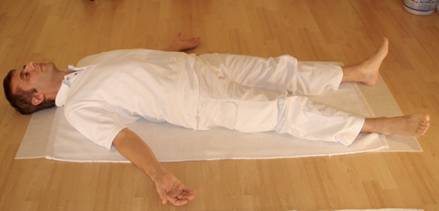
    ·         In a quiet, private place, sit in a comfortable seated posture that you can hold for a long period with your core supporting you (not against a backrest), or, if you’ll be more comfortable, lie down in savasana. Close your eyes throughout the meditation, and bring the focus of your mind’s eye to your body.

    Image003

    ·         Breathe deeply and steadily in through your nostrils into your tummy, then into your chest and heart space then up to your shoulders and neck — and slowly and intentionally release down in reverse order from the neck through the bottom of the tummy.  Inhale only through the nose, but you can exhale through both the nose and mouth, allowing whatever is most easeful for each breath.

    ·         Make the length of your breath on a 1 to 2 ratio.  So if you do a 4-count inhale, do an 8-count exhale.  Find a comfortable, sustainable pace, and don’t focus too much on the exact timing – it’s just a rough guide – but don’t forget to remind yourself either when needed.  Your body will inform you with each breath what it most needs. 

    ·         Once you’ve found a steady pace at about this 1:2 ratio, continue breathing long, deep breaths in this manner, and, as you inhale, visualize sending the breath all the way to the place in your body that needs healing and allowing that part of your body to fill up with healing energy, as your torso fills with breath.  As you exhale, visualize the body gently releasing some of the pain, resistance, anxiety,  sadness, or toxins from that part of your body, and the out-breath carrying it away, out of you.

    ·         At  any point, it may happen that the part of the body you are focusing upon suddenly feels much more easeful or less painful, and seems to have had ‘enough’ healing for now, and  some other part of the body will register the need for healing energy. When it happens, honor it, give thanks to that part of your body for healing itself – and with your next breath, you can shift your visualization of healing energy to the next point in your body asking for it. 

    ·         This works on any part of the body, not just over the parts over which you have conscious control —  even your brain, your heart, the insides of your bones, your eyes, anywhere — you don’t need to be able to consciously control the function of a part of your body in order to send healing energy there.

    ·         Continue for at least a few minutes, as long as you wish, up to a few hours even. 


    If at first you can’t feel your healing energy focusing itself where you’re visualizing, don’t worry – it’s in you. This will become more apparent the more you relax into it.  Often, I know it’s beginning to work because I feel a mild tingling in that region of my body I’m focused on – quite literally, my cardiovascular system is relaxing in that area, allowing more blood to flow in, and with it, more healing happens – more nutrients, oxygen, and white-blood cells go to that part of me — and more red blood cells to carry away by-products and toxins.  With some practice, you will be able to focus your healing energy wherever it is most needed with ease, and the sensations will be unmistakable. 

    If you’re comfortable with this simple practice, you can experiment — as you breathe out, while keeping focused in the flow of healing energy through the body with the breath, you can experiment with different out-breaths and sounds — nose-only, mouth-only, sighing, cooing — whatever is most easeful, whatever provides the most release.  One that really helps me is to sigh like I’ve just finished a big job.


    For those with old emotional wounds – often currently expressing themselves through depression, anxiety,  compulsivity, or trouble focusing or sleeping — coupling this exercise with yogic postures can help accelerate the healing process tremendously.   Deep emotional releases may occur, as there are often many tensions held in the body from un-processed events over the years.  For example, bodywork healers have long known there is often tension stored in the deep musculature of the hips to do with old injuries to one’s emotional security.


    One such experience I have had is of emotional memories coming up of the loss of my grandfather, who was I’m told was my ‘best buddy’ as a small child, until I was two years old, when my family emigrated to America.  He died shortly thereafter. I have no visual, cognitive, olfactory or other memory of my grandfather, but I did have emotional memories of my loss of him held deep within my body, that came up through the combination of this deep releasing breath and pigeon pose on my left side.  I found myself quietly crying tears I had needed to for nearly thirty years, re-connecting with the spirit of a man I had long thought I’d lost, and feeling my load in life is a good bit lighter ever since.


    As soon as you’re just a bit comfortable with this practice and can quickly focus your healing energy  —  you can try to do it any time of day while doing anything – simply taking a deep breath and directing the healing energy to whatever part of your body may be tight or troubled.  For me, it works especially well to direct the healing energy to the front of the brain when I’m a bit mentally astir about something, and the tummy when I’m anxious.   I’ve done it often at my desk at work, in the line at the store, walking down the street, even in the middle of a challenging conversation.  When I can do it, it always helps me — let me know if it helps you too!