Tag: meditation

  • SEPTEMBER Somatic Experiencing Mnemonic

    A memory aid for rapid application of Somatic Experiencing technique for PTSD discharge.

    Numbered text below taken verbatim from p. 75-76 of Dr. Peter Levine’s
    In An Unspoken Voice: How the Body Releases Trauma and Restores Goodness.
    I strongly recommend purchasing and reading the book, and working personally with an experienced practitioner before attempting to apply this mnemonic in a self-directed way.

    S – Safety: 1. Establish an environment of relative safety.
    E – Exploration: 2. Support initial exploration and acceptance of sensation.
    P – Pendulation: 3. Establish pendulation and containment: the innate power of rhythm.
    T – Titration: 4. Use titration to create increasing stability, resilience and organization. Titration is about carefully touching the smallest ‘drop’ of survival-based arousal, and other difficult sensations, to prevent retraumatization.
    E – Empowerment: 5. Provide a corrective experience by supplanting the passive responsees of collapse and helplessness with active, empowered, defensive responses.
    M – Mobilization: 6. Separate or ‘uncouple’ the conditioned association of fear and helplessness from the (normally time-limited but now maladaptive) biological immobility response.
    B – Breakthrough: 7. Resolve hyperarousal states by gently guiding the ‘discharge’ and redistribution of the vast survival energy mobilized for life-preserving action while freeing that energy to support higher-level brain functioning.
    E – Equilibration: 8. Engage in self-regulation to restore ‘dynamic equilibrium’ and relaxed alertness.
    R – Re-connection: 9. Orient to the here and now, contact the environment and reestablish the capacity for social engagement.

    Using the SEPTEMBER mnemonic to personally apply the Somatic Experiencing technique has been instrumental for me in safely working with and discharging traumatic charges.

    __
    SEPTEMBER mnemonic text & this page is copyleft Vikram Surya Chiruvolu, 2012. 

  • Evolving into Love through Self and Non-Self

    A persistent topic among my Insight Meditation circle of friends is that of anatta — non-self.  

    On this theme, a quote from Tricycle’s Daily Dharma was recently shared:

    The Limited Mask of Self
    Of all the words we use to disguise the hollowness of the human condition, none is more influential than ‘myself.’ It consists of a collage of still images—name, gender, nationality, profession, enthusiasms, relationships—that are renovated from time to time, but otherwise are each a relic from one particular experience or another. The defining teaching of the Buddhist tradition, that of non-self, is merely pointing out the limitations of this reflexive view we hold of ourselves. It’s not that the self does not exist, but that it is as cobbled-together and transient as everything else. — Andrew Olendzki, Self as Verb

    I decided to write about it here because anatta is an especially useful meditation topic for me right now, as I’ve been deeply challenged by the passing of my niece earlier this year to have some clarity on whether I believe in a soul that persists across lifetimes, and how this relates to karma and rebirth.  

    A super-natural (ie, more than simply biological/physical) notion of a Universal Self (atman) and a personal soul (jiva) is deeply wound into Hindu philosophy, and into Tantric buddhist traditions — in which a soul enters a body at birth (or perhaps conception) and leaves a body at death, and this soul has a “self”, an identity in some sense, that is subject to karma, rebirth and liberation.

    When family asked me what I thought of all this, and how it relates to my niece’s soul’s journey — I realized this is an aspect of spiritual life with which, while I have read and heard the teachings of great masters and practiced my family’s traditional faith to some degree — I really have had no direct experience per se, and I felt nothing much of substance to offer …  

    But it’s right and good to ask such questions, if at least to honor the departed, and perhaps even  to come to good answers for oneself on the journey. I had to do this once before, when my father passed.  As his eldest son, I performed the funeral rites and good works in his name in careful accordance with Vedic injunctions, which are said to aid in the freeing of his soul to depart this world peacefully, and to join the abode of our family’s ancestral souls.  Doing so helped heal me, and my family, and in some sense that was his unfinished karma with us.  In the process, I developed a loving, living memory of my father that is with me still.  However, in the process, I did not feel I came to know in any ultimate sense whether he had a soul, and if so, whether it went to the abode of the ancestors or the abode of Vishnu, or what have you.  The rites helped us, the living, make our peace; this was reason enough to do them.    

    I’m trying to find answers again, anew, and I see that over the years since my father passed, I’ve come to believe not in a personal soul per se, but that there are streams of karma embedded in one another, complex interleaving patterns of life and existence that repeat and evolve over time, and that these are reflected in, and in some sense, carried forward by physical reality — the complex patterns in DNA, in cells and organs, in language, in culture, in the environment — that what philosopher Ken Weber calls holons (levels of reality which are at once whole unto themselves in one sense, but also inextricably part of a larger order of existence) do exist, and that these do have some literal continuity in between their phases of arising and passing, are embedded in physical reality that assert themselves over over lifetimes and aeons, that these, in much the sense Darwin suggested for species, do evolve.  And this evolution occurs at every level of reality, that it can be an interpretive frame for the entirety of nature.

    So perhaps in some sense it can be meaningfully said these levels each have a ‘soul’ or a ‘self’ that is the encoding in the physical reality from which they arise, and in which they operate, of how they come to be just so …   But I’ve also come to believe that it’s a somewhat arbitrary or perhaps simply an aesthetic choice to believe this, as opposed to non-self; that these are all impersonal streams, that there is no special particularity and persistent identity to any one of them….

    The wikipedia entry on anatta (non-self) mentions how it’s commonly subject to the fallacy of reification — unskillfully asserting that an idea is more concrete than it is intended to be.  For me, being aware of this fallacy is the key in applying the anatta teaching — not forcing it to be more concrete than is really useful or observably true.  And anatta is highly abstract; it takes aim at the very subject-object frame underlying in our usual process of abstraction. Just like dukkha (suffering) and anicca (impermanence), anatta is a powerful insight to achieve liberation from the usual conditions of our thinking & existing… Pick up the tool when useful; set down when not.

    It wouldn’t be useful to focus so morbidly on suffering or impermanence that one loses the ability to undertake daily activities of living.  At times, I have been capable of a degree of such existential darkness.  Not helpful or skillful.  A bit wiser now, I carefully try to avoid this.   Likewise with anatta.  There is a self needed to eat, sleep, go to the bathroom, pay the bills, and also grieve loss, feel joy, serve others, give care, and meditate, contemplate, etc.  Refuting the existence of the self on this level in the name of anatta is not the point of the Buddha’s teaching.  As the saying goes — before enlightenment, fetching water, chopping wood; after enlightenment, fetching water, chopping wood…
    The point for me is to get free of my clinging to this frame of subjectivity (aka “self”), that comes with all sorts of fears and limiting beliefs about what I can do, what I need, who I should associate with, why I’m here.  To see my idea of “me” as “cobbled-together and transient” is to open to the power inherent in the meditative and contemplative process — to get a glimpse of the long-suffering, impermanent, groundless being that is “me” — so I can have the choice to do something useful with it, and not be compelled by this “me” to react, to cling, to avoid, to suffer. 

    I can direct this “me” to serve to free all beings, in the spirit of the bodhisatva vow.  Or at least, freely choose my karmic output — to react, to cling, to avoid, or whatever, if that’s what is most useful to do.  Or, to choose to believe I am part of a larger Self, that is Love.

    Various Buddhist teachers use the construction ‘selfing’ from time to time.  “Oh there I go, selfing again.”  Thinking obsessive thoughts of — What about my … (career, home, marriage, politics, ideas, friends, children) … ?   Yes, well … what about them?

    Insofar as they’re useful & helpful things to be ‘mine’ — I say let them be yours — use this construct, take their help…  But it’s important to see they’re not inherently, actually ‘me’…  They’re just what I’m identifying with as ‘mine’, for now.  It’s like the Native American notion of land ownership; we’re really just temporary stewards, not holders of a permanent dominion.  I’m the temporary steward of this suitcase of experiences, ideas, feelings, preferences, tendencies, atoms and cells that I call “me” and “mine”.  I am free to re-arrange the contents of that suitcase at any time; to do so, it is often helpful to unpack it completely and get clarity about what is in there, and discard what will not serve for the journey ahead.

    So anatta is a teaching that reminds me to not hold on so tight to all that we usually do …  To chose a relationship to ‘my’ story and stuff that is useful in getting free of fearfully dwelling on ‘what about me’ — but to retain a useful sense of stewardship and prudence in all those things I’m connected with … That is a real need, of practical, spiritual life…

    But then, sometimes you don’t want to get free of ‘me’, nor should you, and it doesn’t help to try; it may even feel wrong, like a shortcutting of our essential humanity.   For example, when the particular ‘me’ in question is a beloved child who is no longer here in the body — it’s not much comfort to say, “Well, she had no self, no soul in the first place, so the loss we’re feeling, and the grief and the questions about where she is, what happened to her spirit, what’s happened to her karma — they’re misplaced…”  No. That’s not helpful.  It won’t do at all.

    Love is real; to the extent that we love one another with our limited idea of “self” intact, that “self” is real. Love deserves celebrating every win and grieving each loss.  It can be dangerously shortcut by detaching or dissociating through conceptual meditation or philosophizing on non-self.  At such times, focusing on dukkha and anicca, suffering and impermanence can be much more healing. That said, anatta can expand the frame of belief to provide a healthier, more sustainable idea of  what is a win, what is loss, and who or what even is loving and is being loved.  It can help open the door to seeing a Love that is bigger than any of us, than any narrow “self”, and in which we can all abide.

    In this way, I believe life can be full of great joy, that we do really love, and our love for one another is part of a bigger Universal Love that is ever-present.  I can, by letting go of my past conditioning through contemplating and realizing the application of anatta, choose to consciously align myself with this Love, and to practice the courage to love completely, which comes with a price — with inevitable and sometimes unexpected and tragic loss.  

    Buddha’s teachings on suffering, non-self, and impermanence are profoundly useful tools — in awakening compassion, in freeing the mind, in surrendering our clinging and aversion — in cultivating detachment.  So are Krishna’s teachings on dharma, the journey of the individual soul, and the Eternal.  But neither are the final truth for me, just beautiful tools.   

    For me, the deepest truth is in how we’re consciously evolving into Love, here and now, on every level, in this moment.  When my eyes are open to that, when I participate in that — I am in Truth, and it transcends any teaching or practice. 

  • Getting started with meditation

     A friend recently asked me about my view on how to get started with meditation.  Here’s my answer in the form of five keys.

     The first key is — know that meditation is anything that centers you, purposefully. Different people at different times in their lives have different practices that help them meditate, because there are different causes of being off-center and an endless number of methods of intentionally re-centering.  In addition to very traditional methods of sitting meditation, I personally know people who meditate by knitting, running, playing music, martial arts, painting, attending support groups, and many, many other things.  One of the most important things about re-centering, finding balance, is that it’s a mainly just-for-today thing, a constant course-correction process. 

     Which leads to the second key — spot check. Take one minute to do a back-of-the-envelope inventory. How are you doing in terms of balance in some key areas — rest / activity, diet / elimination, work / play, solitude / social time, mental / physical, stability / change?  You may have your own axes of assessment — use them.  The key is to see if there any areas where you’re consistently further to one end of the spectrum than you know is healthy for you, or are falling short of what you really want or need?  Once you are in touch with what’s not quite right about the complexion of your life right now, ask, what can I do that might help?  Try to keep the answers simple and specific– like — “need more quiet”, or “get exercise” or “make music” or whatever.

      Over time, make the spot-check a continual habit. I’ve benefited from setting a timer on my computer or cel-phone for various lengths of time or times of day — every six minutes, every hour, at meal-times, before bed, etc, to pause and do a momentary check-in and undertake a gentle course-correction.  The more frequent the course-correction, the gentler the invention usually.  If it’s every six minutes, I usually just take a deep breath, stretch my arms or twist in my chair, and continue what I’m doing.  If I don’t do it for weeks or months, I can need a long vacation and lots of effort to find that clarity and center again.

     The third key is — creative action. Once you know what you need, choose a simple practice or method to help begin to restore personal balance — ideally, a way you’re already know you are pretty skilled with or enjoy.  For some people, having solitary highly-focused desk jobs and car-based commutes, the key things they need to restore balance is vigorous exercise of some kind and an opportunity to be social in a creative way, like playing music or dancing. For others, who are working on their feet, dealing with the public, multi-tasking, using public transit, the key thing is time to be alone and do something very simple, like sitting quietly just watching the breath rise and fall.  Choose a practice that you know you can definitely do — it really can be anything that you think will work to help center you, like sitting quietly for ten minutes just observing your mind, or going for a short jog, or jamming out musically with friends once a week. If you’re choosing something you’ve already done before — sport, art, music, just sitting doing nothing — it’s important that you now choose to do this practice with a primary intention of centering yourself, of restoring balance in your self and in your life, not with any external goal. That’s what makes it meditative; without this intention clear, it’s just not going to work consistently as meditation.

      The fourth key is — commit to a regular effort.  When getting started, make the commitment for a brief but substantial time frame, say ten minutes a day for three weeks, or once a week for an hour for six weeks.  Then, see if the benefit you experience is worth it.  Especially when starting out, the deeper benefits require some consistency to realize themselves, so an initial commitment to a specific practice for a specific time frame to get yourself over the hump is key.  For me, I have three 1-hour commitments to yoga and meditation on different evenings of the week that I do with groups, and I put them into my calendar and treat them as real and important as any other appointment, deadline or commitment in my life.

      Fifth — get curious. Be open.  Go where the practice leads you. Whatever the specific practices of centering you work with, as soon as they start to work, you are likely to become  inspired to deepen your knowledge and connection to various techniques or traditions behind them. Honor that curiosity, that calling–for many, it is the most powerful way to opening new creative possibilities, resolving long-standing issues, and fostering personal growth that leads to greater peace, contentment and success.  

      Last (same as the first) — remember the point. Like anything in life, if you don’t experience the benefit, you won’t continue for too long. So this is the single most important thing for the beginner — do not confuse the various techniques and traditions of meditation for the essence of it.  The essence of meditation is centering, and you can achieve this on your very first day of conscious effort at taking a spot check, choosing a practice, and doing it.  

      As your practice deepens and evolves, the techniques and traditions can open up new possibilities and new growth but they still should be done with this basic intent firmly in mind.  There is an art or a science to many practices, valuable for their own sake as well, and the specific mental, verbal, physical, breathing and movement techniques of meditation that exist can lead to tremendously accelerated growth and deeper peace. Yet when those aspects overshadow the basic personal purpose of centering, it’s time to remind yourself of this purpose, and either accept that what you’re doing is no longer meditation, or return to doing it in a way that is.  So remind yourself of this intention whenever you begin practice and whenever it seems to have slipped away in the course of doing it, and you’ll again experience the benefit. This mindfulness is key to any practice working.  

      So these five keys are what make any method of meditation work: mindfulness of intention, regular spot-check, creative action, commitment, and curiosity.  Keep applying these and whatever shape your meditation efforts take, you will experience the benefits and make steady progress.
  • Paths Many–Truth One

    In response to this article from Dr. Aseem Shukla in the Washington Post online entitled The Theft of Yoga, and comments from Deepak Chopra and many others — Love and Light to you all!

    In the healthy debate over the origins and intentions of yoga,  please let us not lose sight that – in those first ancient words of the Dao De Jing – The Way that can be spoken is not the True Way. 

    Hinduism, Yoga, Hatha, Dharma, Asana ….  These are all made-up words, first created by seers to aid seekers on their path.  Then, others carried those words beyond those first compassionate offerings — some in the same spirit –but others to build walls of ignorance out of fear, walls through which seekers must even now struggle to move through.   Either way, the words were never, and even now, are not Truth.  At best, they are aids on our journey.  At worst, they are sources of division and difficulty.   

    Let us pray we choose to allow these words to aid…. And may we reaffirm now in our hearts — words are not Truth and cannot contain Truth.

     Only We can do that, in how We live, and love and serve one another.  This is true regardless of the place, time, and nature of the chosen path. 

    Whether through athleticism (hatha), devotion (bhakti), song (bhajans and kirtan), service (seva), ritual (tantra), sacrifice (yajna), sensory indulgence (vama), renunciation (sanyaasa), individualism (ahamkara), communism (saamyavada),  knowledge (jnana), investigating the mind (raja-yoga), repetition (japa), life science (ayurveda), dance (natya), martial arts (dhanurveda),  despair (vishada), fellowship (sangha),  spiritual suffering (tapas), laughter (haasa) —  all these, and many other approaches, tools and methods — when practiced with the spirit of sincere seeking, have led people in every place and time to awakening, and to people teaching one another how they did it.

    Some paths explicitly set out with that aim, but all paths arrive at it eventually, through the inherent virtue of their sincere practitioners. This consistent fact — that people awaken to Light and Peace whenever they honestly try — this is the evidence that there is a Truth, and that It is beyond all words and methods, and is reachable by anyone.    

    This is as true in America today as it was in ancient India, which is why above I used the English words for these diverse practices first — they are techniques, just as scientists use in the lab.  They are not the province of any one culture, but, while they have their historical and cultural roots to some extent in particular places and times, they are our common human heritage. 

    In America, it is the founding premise of the republic.  Jefferson wrote in the American Declaration of Independence –

    We hold these truths to be self-evident, that all men are created equal, that they are endowed by their Creator with certain unalienable rights, that among these are Life, Liberty and the pursuit of Happiness.

    America begins speaking of self-evident Truth.   

    Yoga is  ancient India’s name for the process of awakening to this Truth – of coming into Union — whatever the path. But Union with what exactly?  A traditional answer is Union with Truth, God, the Infinite, the Universe, or however you call your higher power.   

    My experience on my path thus far is that when one experiences this Union, it can happen as a sudden intuition of mystic unity with all that Is.  I had such a moment when I was 19,  in my home near Washington, looking out at evergreen trees, and realizing that we are not separate, that everything is deeply bound together, that even in that moment, I was breathing in the air they had just breathed out, that always, we are in this intimate, interwoven web of life and being.  

    That experience I cherish, and it led me to my first deep relationship with a spiritual teacher — my great Uncle NC Surya.  But I’ve also seen in the years since that the more substantial change occurs gradually, in stages, as the intuition of unity takes a great deal of work to integrate fully, and the more it does, the more the ‘with’ part (of Union) slowly drops away — there is less and less of an other with which to unite.  It is a state of completeness or fullness unto itself.  In this way, the Self evidences Truth, by direct experience.

    In America, reading revolutionaries like Paine or Jefferson, or philosophical forefathers like Locke, one is hard pressed to imagine that these men didn’t also have spiritual experiences and lives.  Somewhere, they found the courage to imagine and bring into being a society based on such self-evident Truth as the equal rights of all.   Yes, it was deeply flawed — they were not perfect any more than many Indian swamis and yogis who still, at some level even if not publicly, cling to ancient caste, class and gender distinctions. 

    The beautiful thing is  — in America,  awareness of self-evident truth is not some rarefied state only some select few attain; it is our birthright.  In India, living in this Truth is well understood to be our most universally shared experience — not only with countrymen, but all human beings, other animals, plants, the Earth, Sun and stars. 

    In any place, we can just forget or ignore it sometimes (or a lot), and separate ourselves from each other, believing how we differ is greater than what we share. 

    That is a great falsity.  We are One.

    The ancient Eeshavasya (“Lord’s Abode) Upanishad is a revered mantra which beautifully expresses Union, as that fullness or completeness, which is the Lord’s Abode, the dwelling-place of Truth:

    Purnamidah Purnamidam
         That is complete — This is complete
    Purnaat Purnamudacyate

        From That Completeness comes This Completeness
    Purnasya Purnamadaya

        If we take away This Completeness from That Completeness
    Purnameva Vashishyate

       Only Completeness remains

    Click here to download this beautiful recording off Ravi Shankar’s Chants of India. 221 KB

    … So …  Relax. You are held — in Truth, in Completeness – and so are we all.  When that sense of ease arises, then Union with that Truth which cannot be spoken, is possible.

    Now what is the aim of this Union and the peace that comes with awakening to It?

    When an ox, famer and plow are yoked together, they create a new life-giving entity that prepares the field to issue its bounty. The point is not merely to learn intellectually how to unite the ox and plow, or even to do it just once; that is but the beginning of the useful work that happens.  Once united, the ox, farmer and plow have their ultimate purpose fulfilled in the harvest, and that bounty is also dependent on their careful cooperation with nature, and grace of Earth and Sun to provide life-giving conditions. 

    Similarly, yoga is the work of plowing the field of life, of staying connected to Truth, and serving It.  So it is with all forms of sincere seeking – growing in a deep, heartfelt, intuitive way into one’s right relation to the universe and oneself — as a part of a whole, as a part that can see and know the whole, and thereby honor it and make the conscious choice to align with it. This work naturally, gradually gives rise to the life of service that results from such Union. 

    Just as there are many processes by which one may experience such Union, there are even more ways in which this knowledge in turn issues out in action — through love, service, generosity, devotion, art, inquiry, scholarship — these are but a few ways of honoring one’s own Truth, of enjoying the experience of It while fulfilling one’s duty  to abide It.

    Being a yogi is in fact our natural condition.  It is our choice, whether to invite all the words, ideas, and practices either to lead us astray into confusion, conflict and harm, both internal and external – or to lead us back home into our Selves, our Truth. 

    So, once again — we must remember always, the Way that can be spoken is not the True Way.   The True Way is found only in our own experience on our own path, and it is our personal Truth.   One way I feel I have drawn closer to It is when I can recognize deeply, intuitively know, that my experience of It is the same Truth that others have found, that there is but One.

    Along the way, I’ve long felt there’s no great mystery to awakening people once I learned what  — usually, they are deeply humble, non-judging, and forgiving, ever growing in dignity, in their capacity to love themselves and others, in laughter and joy,  in their ability to behold beauty, and in being true to their heartfelt calling in  life.  To me, this is the real-life four-dimensional moving picture of yoga.  It knows every country and language and every era. 

    So finally, with the frame in which we are asking the question on firm ground — we can meaningfully turn to the debate of Dr. Shukla and Dr. Chopra – is yoga as practiced in America aware enough of its roots in Hinduism? 

    My view is that I say this is not a good question to ask, for three reasons. Two I’ve already addressed — first, the falsity of discursive, verbal truths, and Truth of direct experience — and second, the understanding that the essence of yoga is universal — that yogis have been in every era, in every place.  

    So the answer for each of us on a personal level depends entirely on whether we have yet come to know what is our personal yogic path, and whether we are called to the ancient Vedic, Buddhist or Christian roots, or to the modern, diverse global branches of every kind.  None are wrong; they are simply preferences for an entry point to a Universal journey.  They all lead to the same place, even if they are not trying to lead anywhere, if we are sincere seekers, the needed path will reveal itself.  The Truth is that powerful. 

    If you are called to the Vedas or asceticism or rigorous hatha practice, wonderful!  These are tried and true ancient paths.  They are often slow, but sure.  If you are called to modern teachers and teachings, that’s wonderful too. 

    Even drug abuse or gluttony or sexual addiction can serve the intention to find freedom from suffering, if one has turned to those things sincerely seeking a way out of suffering and into the light, even those clearly harmful paths will reveal Truth in due course, by demonstrating the wisdom of abstinence or moderation as appropriate for you, and leading you to people who can help you along such a path. Needless to say, those are far riskier and more painful roads, and the suffering you endure may overwhelm this body you inhabit, before the needed moment of clarity and awakening arrives in this lifetime.  

    But the awakening to Truth can also come much more decisively and quickly, if one chooses to use the pain of their path as fuel for spiritual growth.  I have seen many, many people come into direct and deep communion with their Higher Power in just such a way, of healing the pain of various self-imposed harms, then leading the way to healing the pain of all our life experiences, our past karma. 

    Karma lives on in many ways — painful memories, phobias, prejudices and other serious inexplicable or irrational limitations, harmful personal habits, and diminished feeling of freedom and joy that is our natural state when we feel deeply loved, respected, and useful. 
    For me, directing healing intention and gentle action toward healing past karma is the basis of why any path works: whether that is through asana (postures) or talk therapy or any sincere striving.  In the presence of sincere striving for anything — whether relief from the pain, whether riches, fame and fortune or whether for spiritual attainment — Truth will eventually put you face to face with your karma. Any path, so long as you are true to your desire to be free of suffering, can heal it.

    In the end, yoga is the universal inner calling to seek and find and grow into Truth —  there is no wrong choice, no universally right method — there is just the next step on a wonderful path opening out before us in the present moment. Any tradition, any experience can enrich and inform us — whether the preserved words of ancient Avatars like Krishna, or an interaction with a homeless person, or yet another moment of our routines of life — if only we allow it.


    Om Lokah Samastha Sukhino Bhavantu
      May we humbly pray that all beings everywhere be happy and free

    Om Shanti Shanti Shanti
      Humbly we pray for peace, peace, peace

    Om Shree Gurubhyo Namaha
      Humbly we bow in reverence to all those who have removed darkness from our path

    Hari Om
      To that Truth which Sustains All, we pray humbly


  • Healing Visualization Meditation

    If there’s any part of my body in need of healing, whether from a fall or other injury, from being ill, or tension caused by stress, sadness or resentment — there’s a simple healing visualization meditation using the breath that I’ve found always helps me feel better.

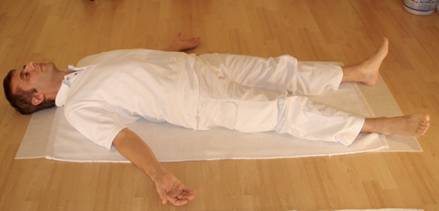
    ·         In a quiet, private place, sit in a comfortable seated posture that you can hold for a long period with your core supporting you (not against a backrest), or, if you’ll be more comfortable, lie down in savasana. Close your eyes throughout the meditation, and bring the focus of your mind’s eye to your body.

    Image003

    ·         Breathe deeply and steadily in through your nostrils into your tummy, then into your chest and heart space then up to your shoulders and neck — and slowly and intentionally release down in reverse order from the neck through the bottom of the tummy.  Inhale only through the nose, but you can exhale through both the nose and mouth, allowing whatever is most easeful for each breath.

    ·         Make the length of your breath on a 1 to 2 ratio.  So if you do a 4-count inhale, do an 8-count exhale.  Find a comfortable, sustainable pace, and don’t focus too much on the exact timing – it’s just a rough guide – but don’t forget to remind yourself either when needed.  Your body will inform you with each breath what it most needs. 

    ·         Once you’ve found a steady pace at about this 1:2 ratio, continue breathing long, deep breaths in this manner, and, as you inhale, visualize sending the breath all the way to the place in your body that needs healing and allowing that part of your body to fill up with healing energy, as your torso fills with breath.  As you exhale, visualize the body gently releasing some of the pain, resistance, anxiety,  sadness, or toxins from that part of your body, and the out-breath carrying it away, out of you.

    ·         At  any point, it may happen that the part of the body you are focusing upon suddenly feels much more easeful or less painful, and seems to have had ‘enough’ healing for now, and  some other part of the body will register the need for healing energy. When it happens, honor it, give thanks to that part of your body for healing itself – and with your next breath, you can shift your visualization of healing energy to the next point in your body asking for it. 

    ·         This works on any part of the body, not just over the parts over which you have conscious control —  even your brain, your heart, the insides of your bones, your eyes, anywhere — you don’t need to be able to consciously control the function of a part of your body in order to send healing energy there.

    ·         Continue for at least a few minutes, as long as you wish, up to a few hours even. 


    If at first you can’t feel your healing energy focusing itself where you’re visualizing, don’t worry – it’s in you. This will become more apparent the more you relax into it.  Often, I know it’s beginning to work because I feel a mild tingling in that region of my body I’m focused on – quite literally, my cardiovascular system is relaxing in that area, allowing more blood to flow in, and with it, more healing happens – more nutrients, oxygen, and white-blood cells go to that part of me — and more red blood cells to carry away by-products and toxins.  With some practice, you will be able to focus your healing energy wherever it is most needed with ease, and the sensations will be unmistakable. 

    If you’re comfortable with this simple practice, you can experiment — as you breathe out, while keeping focused in the flow of healing energy through the body with the breath, you can experiment with different out-breaths and sounds — nose-only, mouth-only, sighing, cooing — whatever is most easeful, whatever provides the most release.  One that really helps me is to sigh like I’ve just finished a big job.


    For those with old emotional wounds – often currently expressing themselves through depression, anxiety,  compulsivity, or trouble focusing or sleeping — coupling this exercise with yogic postures can help accelerate the healing process tremendously.   Deep emotional releases may occur, as there are often many tensions held in the body from un-processed events over the years.  For example, bodywork healers have long known there is often tension stored in the deep musculature of the hips to do with old injuries to one’s emotional security.


    One such experience I have had is of emotional memories coming up of the loss of my grandfather, who was I’m told was my ‘best buddy’ as a small child, until I was two years old, when my family emigrated to America.  He died shortly thereafter. I have no visual, cognitive, olfactory or other memory of my grandfather, but I did have emotional memories of my loss of him held deep within my body, that came up through the combination of this deep releasing breath and pigeon pose on my left side.  I found myself quietly crying tears I had needed to for nearly thirty years, re-connecting with the spirit of a man I had long thought I’d lost, and feeling my load in life is a good bit lighter ever since.


    As soon as you’re just a bit comfortable with this practice and can quickly focus your healing energy  —  you can try to do it any time of day while doing anything – simply taking a deep breath and directing the healing energy to whatever part of your body may be tight or troubled.  For me, it works especially well to direct the healing energy to the front of the brain when I’m a bit mentally astir about something, and the tummy when I’m anxious.   I’ve done it often at my desk at work, in the line at the store, walking down the street, even in the middle of a challenging conversation.  When I can do it, it always helps me — let me know if it helps you too!

  • Reflections on 2009

    I wanted to conclude the year with a meditation on what proved to be an interesting year for me.  I got engaged and unengaged.  The latter being the hardest thing I’d ever gone through, and I’ve been through my share of tough things.  I also began teaching yoga, and working at the Peace Corps.  I’m grateful to have made it through, and to have re-connected through each of these experiences with my own sense of purpose and meaning, to re-affirm that pain shared is pain lessened. And that lessons shared are lessons learned. 

    1. No single relationship can completely fulfill me. My fulfillment plays out through my relationships with myself, with the entire community of people in my life, and with my God — all of whom will be with me until my last breath.  I, my God, and the people in my community may change but my relationships with each will persist to my last breath.  I can only act with the experience and hope I have gained on my path toward my fulfillment. However, its realization is out of my hands.  When it comes, it comes, and when it goes, it goes.  Pressing forward on the journey is all I can ever do.

    2. However, pressing toward trying to fulfill myself through any one thing — whether a person, an idea or ideology, a substance or behavior — is powerful, subtle and insistent force in me and in many people. I have long known this about myself, and been vigilant of it daily, and yet that cycle arose again.  A strong, clear, convicted sense of self and of the importance of balancing all the relationships in my life toward my fulfillment is the antidote.  I have to take this antidote in every situation in which I feel that pull toward a ‘fixed idea’ that will ‘fix’ me or everything.

    3. Friends are deeply important to my survival and happiness.  They are the people to whom I owe nothing, and who owe me nothing, but we, of our own free choice, give gratefully of ourselves to each other.  The time, empathy, honesty, affirmation, and strength I get and that I am able to give is the very stuff of life. May I also ever be a friend to myself.

    4. ‘We work that we may know the seasons.’ So writes Kahlil Gibran in The Prophet.  Work, being of service to others, is my anchor, to the Earth and to the Sun, and to humanity.  Whatever storm may come, I am always held by the very fact of work, of service to others.  This remembrance of the needs of others restores my perspective, puts whatever wounds or challenges I face, into their right context, as but one small bit of a much grander flow.

    5. In every crisis lies the opportunity for transformation into the being for whom it is not a crisis, but a matter of course.  If I can allow healing of whatever karma it is that causes me to view the situation as a crisis, it ceases to be one.

    6. I may want a life partner, but do not need one. I can be open to the possibility, but I must be aware that in seeking it out, it is possible, in a deep but subtle way, to close myself off to the beautiful fullness of the present moment.   Let me ever remember to be here now, and allow that to make possible futures increasingly obvious.

    7. I love teaching. I am a teacher. I love learning. I am a learner.  For myself.    But I am only ever, at best, a guide to others, a guide to remembrance of their own inner teacher and student. Above all else, guides exemplify. Formal instruction or direction, only if invited and only if necessary, can be but one tool of such remembrance.  However, it must be used sparingly, as there is a great danger in it of putting the student’s own inner teacher and learner to sleep — putting the application or improvement of a faculty or skill at odds with the greater development or realization of the Self.

    9. Highly skilled and gifted people can be quite foolish or confused, as much as anyone can. Oftentimes moreso, because they may mistake their skill or gift for wisdom and clarity, and others who do the same may often encourage them in this mistake.  So be discerning in choosing one’s guides, teachers, and examples.  Above all else, look for people with the humility to be aware of, and in contact with, their own fallibility.

    10. Elegant as it may seem, lists do not have to be ten items long. But while we’re at it, I suppose I also learned that I can keep writing even after a longish absence, that consistency and persistence are not the same, that both are good, and even one is far better than none.

    I end with a note of reverence and gratitude to my late father.  These are his feet.

    Media_http3bpblogspot_vnvbe